

This is not an angry airline rant. I’m going somewhere important with this, so please hang with me.
As a professional speaker based in Denver, business travel is a necessary evil that comes with the job.
United Airlines has a large hub in Denver, and thus, I’ve been flying them almost exclusively for 30+ years to the tune of nearly 3 million actual miles and hundreds of thousands of dollars. No matter the industry, every business needs to recognize and reward that type of loyalty with special perks and rewards, as most do.
Today as I am at DIA preparing to board my flight, I am lined up behind 22 other passengers in Priority Boarding Group 1. There are another 15 or so behind me in this group.
Priority Boarding Group 1 sounds special, doesn’t it?
It’s not, actually.
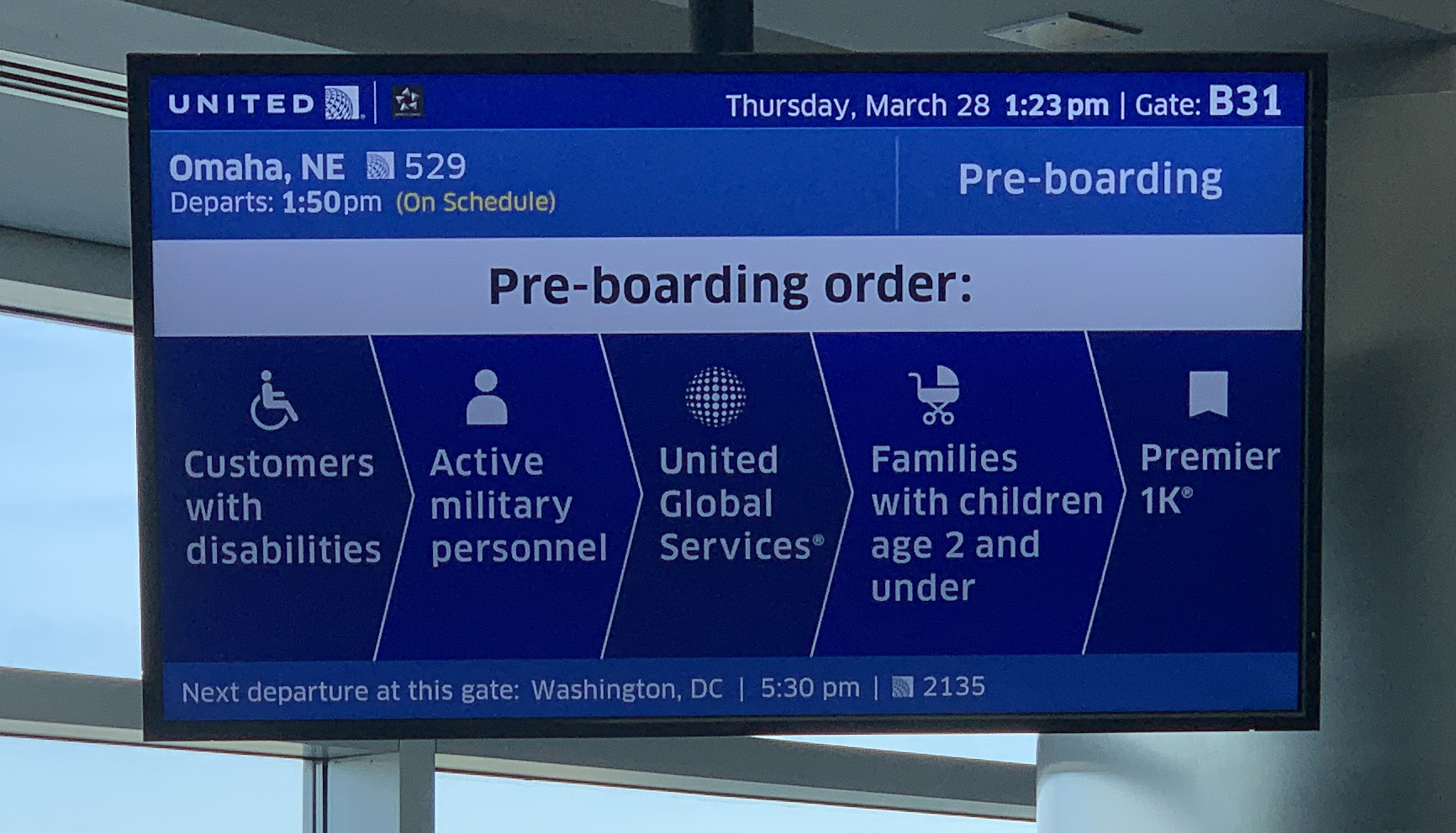
You see, Boarding Group 1 is actually Boarding Group 5, as there are 29 other passengers that will board before the first person in our group is welcomed aboard. (They refer to this as preboarding, but how can one board before they board?)
In order, here’s how United will board its passengers:
- Customers with Disabilities
- Active Military Personnel
- Global Service Members (the highest United status level based upon the dollar amount spent with United in a given year.)
- Families with children under 2 (An entire family of 5 can board providing that one of them is under age 2.)
- Passengers with 1K status (passengers who’ve flown a minimum of 100K miles on United in the previous calendar year.)
- Boarding Group 1 – My boarding group
- Boarding Group 2
- Boarding Group 3
- Boarding Group 4
- Boarding Group 5
Notice that there are more groups boarding before Boarding Group 1 than after. Still, United prominently promotes Boarding Group 1 as well as Boarding Group 2 as their ‘PRIORITY’ boarding. In other words, we’re ‘special’ …at least more special than those in Groups 8, 9, and 10.
In recent years, United—like the other major airlines—has lowered the bar to what they term as their ‘priority’ (special) customers. In fact, they now allow any customer to buy their way into elite status so they can move ahead of those truly special customers who’ve remained loyal over many years. Additionally, they also now permit all elite customers to freely grant their same elite status to a significant other, so that a first-time-ever United passenger who’s been given their brother’s elite status and is flying alone receives preferential seating and priority boarding ahead of a multi-million-mile 30-year loyal customer.
Again, this is not a rant against an airline. (Okay, maybe it is just a wee bit.)
This example illustrates that companies that treat every customer as ‘special’ risk disappointing and demotivating those who really are special.
While every customer should be considered important to your company, and all should be treated with respect and dignity, not all are special and not all deserve special treatment.
ALL EMPLOYEES ARE NOT EQUAL
This principle also applies to the employees in your organization. All are important, but not all are special. And when everyone is treated as special, no one is special. Karl Marx had some interesting ideas along these lines.
When a top performer sees that a low producer is essentially getting treated the same as they are, it’s a motivation killer. When a low performer sees that there is essentially no benefit to being a top producer, they will continue performing at a low level.
Rewards, recognition, perks, etc. should never be put up for sale to the highest bidder, nor should they be given out haphazardly in an effort to make everyone happy.
ON POINT – To inspire outstanding performance and behavior, reserve ‘special’ for those who’ve earned it.