

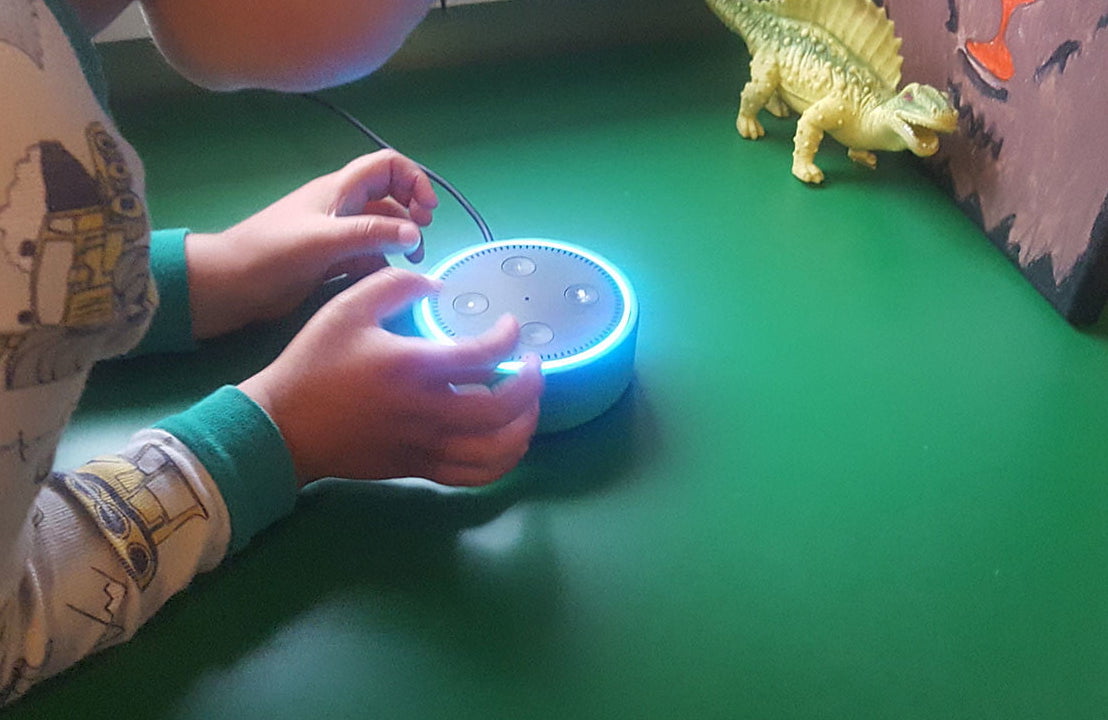
For his 4th birthday, my grandson August (Auggie) was given an Echo Dot for Kids – Amazon’s Alexa for children.
Even though I don’t o wn an Alexa or similar AI device, I thought I was somewhat familiar with what they do.
Turns out, I wasn’t.
I watched Auggie’s face light up when his dad finally got the Echo app installed and connected it wirelessly to his wifi router.
The birthday boy immediately went over to this bright blue hockey puck sitting on the end table and said, “Alexa, tell me a joke.”
Alexa replied, “Why won’t a shark eat a clownfish?” Pause. “Because they taste funny!”
August laughed, even though I don’t think he ‘got it’.
He then said, “Alexa, play Bootyliscious by Beyonce.” (I swear to God I’m not making this up.)
Within seconds, that song was playing.
He then asked Alexa to read him a story – and sure enough, Alexa did.
I’m a fairly tech-savvy baby boomer, but this entire scenario has launched my brain into orbit, and I’m not sleeping very well.
I can’t help but wonder what impact this technology is having on Auggie, and the millions of other kids like him the world over. Is it stimulating their creativity, or destroying it? Is it going to make them passionate learners, or make them think that school, books, and teachers are obsolete and unnecessary?
I then find myself wondering how I would be different, if at age 4, instead of talking to my teddy bear, I’d have interacted with a plastic thing-a-ma-bob that was infinitely smarter than any adult I knew. Where would I be now if I would have had 24/7 access to a robot that could royally entertain me, educate me, and open new worlds for me just by me ordering it to do so like a king to a peasant?
I’m not sure of that answer, but I know that I’d be a vastly different person than the guy who’s currently typing up these thoughts on a Mac. And maybe that’s a good thing.
Look, there’s no turning back. I get that. The genie is out of the bottle. Artificial intelligence is here to stay, and this is a truly game-changing technology that can and will benefit mankind in a myriad of ways.
But let’s be very clear. Artificial intelligence is just that, artificial.
No matter how smart Alexa gets, it will never be a replacement for human contact. While this device can read my grandson a bedtime story and audibly say “good night, Auggie,” it can’t possibly put any truth or meaning behind those three words. It will never have the capacity to care if Auggie actually has a good night’s sleep. And it can’t hug him, tuck him in, kiss him on the cheek, and convince him he is loved.
Thank God, August has two wonderful parents that provide him the care and love he needs. And in this crazy world, that’s no longer a given.
And if you don’t believe me, just ask Alexa.
ON POINT – Leaders need to understand the impact that ever-changing technologies have on young people, many who can’t comprehend life without them. Young brains are wired to demand instant answers and simple solutions, but not to solve problems pragmatically. Moreover, although your emerging workforce may respond to AI-based skills training, they will never reach their potential without caring human interaction.