

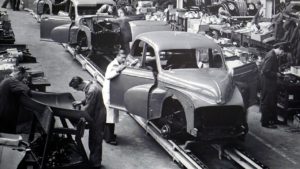
 What we call “labor” today bears little resemblance to its meaning of yesteryear. In fact, during the late 1800’s, one of our nation’s darkest labor periods at the height of the Industrial Revolution, the average American worked 12-hour days and often 7 days per week in order to eke out a basic living. Few other options existed. Restrictions were often ignored and children as young as 5 toiled in unsafe factories, mills, and mines alongside recent immigrants and many of the most economically disadvantaged citizens in our country.
Although they didn’t boast of their efforts, there’s no doubt that these unsung workers took great pride in performing their jobs to the very best of their abilities, and they did much to advance and embody the American dream.
In an effort to improve their despicable working conditions and to pressure employers to make much-needed changes, labor unions were formed and grew in both size and strength. Change was slow, but conditions gradually improved, and the distress over the work environment evolved into the pride of a job well-done. Hard work became an admirable American virtue.
Although there is some dispute as to the actual founder of Labor Day, President Grover Cleveland designated the first Monday in September as a nationally observed holiday back in 1894 to honor and celebrate American workers and their contribution.
Sadly, over the past century, labor has—once again—completely lost its luster. Today the American ethos of “labor” is too-often viewed as something that must be avoided at all costs. Our kids are being raised to believe that work must always be fun, exciting, flexible, rewarding, self-actualizing, highly-respected, and of course, well-compensated. Only a “loser” would do manual labor. (Said with condescending eye-roll.)
Disagree?
What would be your gut reaction if your middle-schooler or teenager came to you and told you that their career objective was to become a dump-truck driver, a carpet installer, appliance repair person, or a maintenance worker? (And please don’t give me that: “…as long as they’re happy,” cliche’. I’m not buying it.)
LABOR MATTERS
If this COVID pandemic has taught us anything, it’s that labor is essential; and more specifically, the labor that most people wouldn’t do. The labor that cleans up our messes and keeps our goods and services moving. And those who perform that work–and who do the job with great pride–should be honored and widely celebrated.
America is bursting at the seams with wannabe actors, social media influencers, athletes, and pop stars. We’ve got more professional skateboarders, pro video game players, and YouTubers than we’ll need in the next 1000 years.
At the same time, America is in dire need of plumbers, masons, restoration workers, and diesel mechanics. We are desperate for senior citizen caregivers, welders, longshoremen, fabricators, and machine operators. And there’s certainly nothing lacking when it comes to the wages and benefits being offered to today’s skilled workers and laborers. But the takers are few and the future outlook for these jobs is dim.
Meanwhile, our street corners are crowded with able-bodied cardboard sign-holding people asking for a handout. Alarmingly, unlike their predecessors of even a decade ago, the cardboard signs they display no longer read “WILL WORK FOR FOOD.” Somehow, the idea of providing something tangible in exchange for your daily bread has mysteriously evaporated. Today, it’s a “GoFundMe page” or simply another hand-out from Mom and Dad afraid that Junior might be sad for 10 seconds that feeds the indolence.
RESTORE THE CONNOTATION
A lot of words, terms, and phrases that my parents and most adults bantered about in their daily vocabulary when I was growing up have since been declared ‘politically incorrect’ and banished—and with good reason. But if ever an age-old term needed to be redefined and restored to its glory with honor, it’s “labor.” Be careful how you use it, especially among the young and impressionable.
So happy Labor Day, America! Let’s salute those who choose to perform the difficult—and often considered “un-sexy” jobs that keep our lights on, our wheels turning, our families fed, and our standard of living so incredibly high.
It’s a world our grandparents would hardly recognize.