

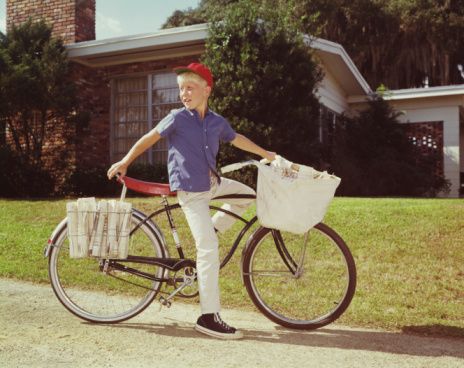
It’s 8:07 am in Denver and the daily newspaper “guaranteed to be delivered by 7 am” is not here.
Again.
And when it finally arrives, it will be thrown from the window of a hail-damaged 2006 Saturn Ion by a 30-something woman, and it will land at the edge of the curb at least 35 yards from my front porch.
Ironically, it has become a newsworthy event in my house when the paper is actually delivered by 7 am.
That newspaper, The Denver Post, was my first employer. In 1970, at age 13, I was a proud paperboy (yes, like the mailman, that was the term everyone used at that time). Back then, the Post was an afternoon paper. Its direct competitor, the now defunct Rocky Mountain News, was the morning daily newspaper in metro-Denver. I was the neighborhood paperboy for that one, as well.
 My job (or my two jobs) was to deliver the “Rocky” to 72 neighbors in the morning and ride the same streets that afternoon delivering the “Post” to 86 neighborhood subscribers. Both papers were to be delivered to their respective subscribers seven days per week, even on holidays. Without exception.
The Rocky guaranteed home delivery by 7 am. The Post by 5 pm.
If a neighborhood subscriber to either paper did not receive delivery by the promised deadline, they wouldn’t call the publisher; they’d call my house.
There was only one phone in our house–a landline shared by a family of seven–and regardless of who answered, if my father caught wind of a dissatisfied neighbor on the other end of the line, no matter what kind of reason or excuse I could possibly dream up, all hell would reign down.
As a paperboy in my early teens, I was inculcated with critical life-changing lessons that are still with me today. In fact, any success I now enjoy can be traced back to them.
5 Crucial Lessons Learned as a Paperboy
An excuse is no excuse. Thunder/lightening, pouring rain, hail, or 3 feet of snow, just make sure the paper arrives on time.
Think ahead and be prepared. Order rubber bands before your box is empty. Make certain you have an extra tube and tire, and master the art of changing a flat on your “paper-bike”. Know where your warm gloves and boots are at all times. Go to bed early because 4:30 am is coming sooner than you think.
Be fiscally responsible. In addition to just delivering papers, the paperboy must collect the monthly bill from each subscriber at the end of every month. The publisher’s bill (Rocky/Post) is the first to be paid. The paperboy gets what’s left. It’s essential to keep accurate records and be vigilant, yet friendly and courteous, in collections.
Customer service matters. Learn each customer’s name and pronounce it correctly (e.g.,“Hello Mr. Kimbalensky, Eric Chester here to collect for The Denver Post”.) and know the wants and needs of each customer (i.e., Mrs. Gordon wants her paper under her welcome mat. The Shafers are on vacation and want all their papers held until the 14th, etc.).
A bonus is exactly that. In some situations, with some customers, if you’ve exceeded expectations, you might get a tip. But a tip/bonus is not a condition of your performance requirements, nor the excellent service you are expected to deliver. Don’t count on them.
The Crisis – and Our Responsibility
With the advent of digital newspapers, and with overall newspaper readership in steep decline, home newspaper delivery is going the way of the local travel agency and video rental stores.
Sadly, there are no more teen paperboys – or papergirls – anywhere in sight, at least not in my town. So if you are old-school and like to read a physical paper while you sip your coffee, the odds are good that your daily paper delivery is on a par with mine. And if you want to register a complaint with the publisher when the paper you’ve prepaid for online via credit card is ridiculously late, as my wife and I have done at least 50 times over the past eighteen months, you’ll talk to a robot that apologizes (as if that atones for your angst), takes down your information, and sends out another delivered by a courier that arrives around noon or so.
Like so many jobs of the 20th century, the job of paperboy has been eliminated, and with it, the work ethic of generations past.
Teen employment in virtually every industry has dropped dramatically over the past 20 years.
And yet, when young people take their first job – or enter their first career position, employers expect them to not only have the required technical skills, they expect them to already know how to work. And regardless of what they’ve learned in a classroom, the vast majority simply don’t.
When they don’t have these crucial soft skills and core work ethic, we blame them. “Lazy good-for-nothing millennials!”
How foolish and short-sighted can we be?
ON POINT – As an employer (business owner, leader, or manager), you can no longer assume that the young person you hire is workplace ready. You have to have a system or a training program in place that inculcates those crucial core work ethic values that young workers should have learned at home or at school but likely haven’t.
The job(s) that would have given them those skills have been eliminated, given to a more experienced worker who is worth the $15 per hour the government has mandated, and/or handed over to a robot.