

One of the questions that I am asked most frequently by business leaders after a presentation is this one:
“With all I am pushed to do already, how am I ever supposed to find time to implement your ideas and tactics?”
Time is, of course, the great equalizer. It’s the one resource that business owners, leaders, and managers never seem to have enough of.
Laura Stack is the preeminent expert when it comes to efficiency and productivity. She’s written several terrific books on the topic, and she has recently turned her expertise toward helping leaders execute on their plans, goals, and objectives.
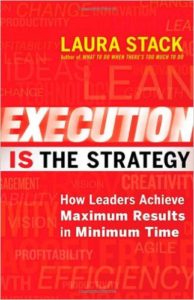
After reading an advanced copy of Stack’s new book, Execution IS the Strategy, I contacted her and asked a few questions:
 ERIC: Laura, the whole process of strategic planning seems to have been tipped on it’s ear in the past few years. Why is that?
LAURA: The five-year plan so beloved of old-school executives, complete with detailed financials and step-by-step implementation, is history. There’s barely enough time to stop and take a breath anymore, much less implement a planning tool that may be stale before it’s a month old. Today’s leaders rely on front-line workers to help them make reliable decisions on how to best execute the objectives that advance organizational strategy.
In my research for this book, I’ve discovered the common denominators of those who are able to go beyond setting goals and objectives and execute on those plans. I’ve been able to identify the four key factors that must be in place successful execution: Leverage, Environment, Alignment, and Drive—what I call the L-E-A-D Formula™ and outlined them in this new book. Each key has 9 components, so there are 36 potential obstacles that prevent leaders from getting things done. (If your followers are interested, they can take the assessment at www.ExecutionQuotient.com to discover their biggest challenges to execution.)
ERIC: The formula you provide is simple and easy to remember. Can you go a little more in depth on these four keys for my readers?
LAURA: Sure, and it’s not just a coincidence that it’s an acronym for L-E-A-D. The factors are as follows:
L- Leverage. In the strictest sense, a lever is a simple machine with a rigid beam that pivots on a fulcrum to magnify an input force, so the resulting leverage can move heavy objects. The concept of leverage works equally well in the workplace with leaders pushing the employee lever on the fulcrum of resources to move the organization. To run an efficient organization, we must leverage all these areas.
E – Environment. Assuming you have the right people and resources in place, have you created the work atmosphere where people are able to execute? A productive, supportive work environment depends on the established workplace culture, the right attitudes toward change, and a strong sense of personal empowerment.
A – Alignment. Like a conductor of a symphony, today’s leader is out front—watching, keeping everyone on the right track, steering team members toward the organization’s strategic priorities, and listening to their best ideas on how to get there. In an aligned organization, employees’ daily activities ultimately achieve the strategic objectives.
D – Drive. As a leader, your greatest importance may lie in clearing the way for your team members. This involves smoothing out the speed bumps and removing any obstacles that block task execution, particularly the procedural ones. Think of yourself as a bulldozer.
ERIC: If execution is so flexible and changeable and is dependent upon workers, why is leadership such an in-demand skill?
LAURA: Today’s leader must articulate the mission, vision, goals, and strategy, while the team defines the tactics, which shapes the strategy, as leaders make the course corrections, in a continuous cycle. Leaders also hold workers to the core values that define their organizations. Ultimately, execution itself is the only strategy that matters. A decent strategy, brilliantly executed, trumps a brilliant strategy poorly executed. As leaders and followers form tighter partnerships, the organizations with stellar strategies that follow the principles of the L-E-A-D Formula will maintain the conditions necessary to hurtle forward.
CONCLUSION: After reading Stack’s newest book, I am firmly convinced that execution is indeed a strategy in itself, and one that today’s leaders must master to remain afloat.
If you want a field guide that can help you create and implement and execution strategy for your business, I highly recommend you pick up a copy of this book.